Bringing Nature to Life: A Practical Review of 3D Butterfly, Bee, and Dragonfly Digital Templates
In the evolving landscape of digital crafting and small-scale manufacturing, the shift from two-dimensional decorations to immersive three-dimensional art has become a significant trend. For creators, educators, and small business owners, finding assets that bridge the gap between aesthetic appeal and technical feasibility is often a challenge. The BUTTERFLY, BEE and DRAGONFLY in 3D digital collection represents a focused solution to this need, offering a suite of vectorized designs specifically engineered for layered paper crafting and laser cutting. Unlike generic clip art that requires extensive modification before it can be cut, these files are pre-configured for immediate production, saving valuable time in the design workflow.
This evaluation examines the utility, file structure, and practical application of these insect-themed templates. Whether you are a hobbyist looking to enhance home decor or an entrepreneur producing inventory for a craft fair, understanding the technical specifications and limitations of such digital assets is crucial before investment.
The Architecture of the Design Files
The core value of the BUTTERFLY, BEE and DRAGONFLY in 3D package lies in its comprehensive file compatibility. In a market where software preferences vary wildly—from Adobe Illustrator users to those relying on proprietary machine software like Silhouette Studio or Cricut Design Space—versatility is key. This collection addresses that fragmentation by providing nine distinct templates (three for each insect species) across six different file formats: SVG, DXF, Adobe Illustrator, SilhouetteStudio, PDF, and PNG.
The inclusion of SVG and DXF ensures seamless integration with most modern cutting machines. SVG files are particularly robust for web-based design platforms, maintaining clean paths that prevent cutting errors. Meanwhile, the DXF format remains the industry standard for CAD-based laser cutting software, ensuring precision when working with materials like cardstock or thin wood. For professionals who prefer working directly in vector editing software, the native Adobe Illustrator files allow for granular control over anchor points and stroke weights, enabling further customization if the project demands it.
It is important to note that these are vectorized designs. This means they are mathematically defined rather than pixel-based, allowing the user to scale the insects up or down without any loss of resolution or edge quality. Whether the goal is to create miniature embellishments for scrapbooking or large-scale wall installations, the scalability of these vectors ensures consistent output regardless of the final dimensions.
Construction Logic and Material Recommendations
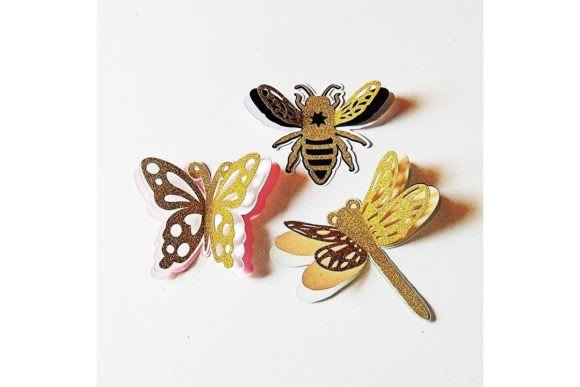
What distinguishes this collection from simple outline drawings is the engineering behind the "3D" aspect. The designs utilize a layering technique where specific segments act as fold lines or connection points. In the context of laser cutting or blade plotting, these fold lines are often designated as cut segments or score lines, depending on the machine's capability. This structural approach allows flat materials to transform into volumetric shapes that mimic the natural anatomy of butterflies, bees, and dragonflies.
For optimal results, the creators recommend using 80 lb cardstock. This recommendation is grounded in practical physics; lighter papers may lack the rigidity required to hold the 3D form against gravity, causing the wings to droop over time. Conversely, materials significantly heavier than 80 lb may be difficult to fold cleanly without cracking, especially along the intricate wing veins found in the dragonfly and butterfly templates. The 80 lb weight offers a "sweet spot" of flexibility and durability, ensuring the finished product maintains its shape while remaining easy to assemble.
The assembly process itself serves as a test of the design's quality. Poorly designed 3D templates often result in gaps between layers or misaligned wings. However, these templates appear to account for material thickness and tab placement, facilitating a snug fit. The separation of the nine templates into three variations per insect provides users with options for posing and orientation, adding dynamic variety to a display without requiring the creator to redesign the geometry from scratch.
Workflow Efficiency and Instant Accessibility
In a professional setting, time is a non-renewable resource. The delivery method of the BUTTERFLY, BEE and DRAGONFLY in 3D files reflects an understanding of this constraint. Upon payment confirmation, the user receives a compressed folder containing all necessary assets for instant download. There is no waiting period for shipping physical goods, which eliminates logistical delays and allows for immediate project initiation. This immediacy is particularly beneficial for freelancers facing tight deadlines or educators preparing materials for an upcoming class.
However, potential buyers must be aware of the nature of digital products. As stated in the product terms, once the purchase is made, the money is not returned. This is a standard policy in the digital marketplace, driven by the fact that files cannot be "un-downloaded." While this may seem strict, it underscores the importance of verifying one's needs and machine compatibility prior to purchase. The vendor emphasizes customer satisfaction and invites communication for assistance with the files, suggesting a support system is in place should technical issues arise during the download or extraction process.
Target Audience and Practical Applications
The versatility of these insect templates makes them suitable for a diverse range of users. Small business owners specializing in handmade goods can leverage these files to create high-margin products such as greeting cards, gift box toppers, or wedding favors. The natural theme resonates well with spring collections, garden parties, and eco-conscious branding.
Educators and camp counselors will find significant value in the biological accuracy and interactive nature of the project. Assembling 3D models of pollinators like bees and butterflies serves as an engaging STEM activity, teaching students about insect anatomy and spatial reasoning. The availability of PDF and PNG formats also allows for non-cutting applications, such as printing reference sheets or digital presentations.
Furthermore, interior designers and event planners can utilize these assets for large-scale installations. Because the files are scalable, a designer could produce hundreds of uniform dragonflies to create a "swarm" effect on a feature wall, or mix the three insect types to create a vibrant meadow scene for a themed event. The consistency of the vector lines ensures that whether one unit or one hundred units are cut, the quality remains uniform.
Limitations and Considerations
While the BUTTERFLY, BEE and DRAGONFLY in 3D collection offers substantial utility, it is not without limitations that users should consider. First, the reliance on specific material weights means that experimentation may be necessary if one wishes to use alternative mediums like acrylic or metal. The fold lines designed for paper may not translate perfectly to rigid materials without adjusting the kerf or bend allowances in the software.
Additionally, the "no refund" policy places the onus on the buyer to ensure their equipment can handle the provided file types. Users with older cutting machines that do not support SVG or DXF may find themselves unable to utilize the primary vector files, though the PNG option offers a workaround for tracing, albeit with less precision. Finally, as with any digital template, the final aesthetic quality is heavily dependent on the user's assembly skill and material choice. The files provide the blueprint, but the craftsmanship determines the outcome.
Final Verdict on Utility and Value
The BUTTERFLY, BEE and DRAGONFLY in 3D digital pack stands out as a pragmatic tool for creators who value efficiency and precision. By offering a wide array of file formats and focusing on structurally sound 3D geometries, it removes many of the barriers associated with custom design. The ability to instantly access nine varied templates allows for rapid prototyping and production scaling.
For those willing to adhere to the material recommendations and understand the constraints of digital purchases, this collection provides a reliable foundation for both artistic expression and commercial production. It effectively bridges the gap between digital design and tangible art, proving that with the right vector assets, bringing nature to life in three dimensions is an accessible and rewarding endeavor.