Evaluating 3D Halloween Pumpkin Laser Cut SVG Designs for CNC Projects
As the autumn season approaches, makers and crafters often seek ways to elevate their holiday decorations beyond standard flat silhouettes. One increasingly popular method for achieving depth and visual interest is through the use of 3D Halloween Pumpkin Laser Cut SVG files. These digital designs are engineered specifically for computer-controlled cutting machines, allowing users to transform flat sheets of material into dimensional sculptures. For individuals researching options for their next project, understanding the mechanics, file requirements, and practical applications of these designs is essential before making a purchase or beginning production.
Understanding the Mechanics of 3D Paper and Wood Puzzles
A 3D Halloween Pumpkin Laser Cut SVG is not merely an image; it is a set of vector instructions that dictate how a machine should interact with a substrate. Unlike traditional two-dimensional cutouts, 3D designs rely on interlocking slots, tabs, and layered assembly to create volume. The design process involves calculating precise kerf offsets—the width of the material removed by the laser beam—to ensure that pieces fit together snugly without being too loose or too tight.
When evaluating these files, it is crucial to understand the standard coding conventions used within the industry. Most professional designs, including comprehensive pumpkin collections, utilize a specific color-coding system to streamline the workflow. Typically, red lines indicate cut paths, instructing the machine to slice completely through the material. Conversely, black lines denote engrave paths, telling the laser to mark the surface without cutting through. This distinction is vital for efficiency, as it allows the operator to run both operations in a single job setup, provided the software interprets the color codes correctly.
File Formats and Machine Compatibility
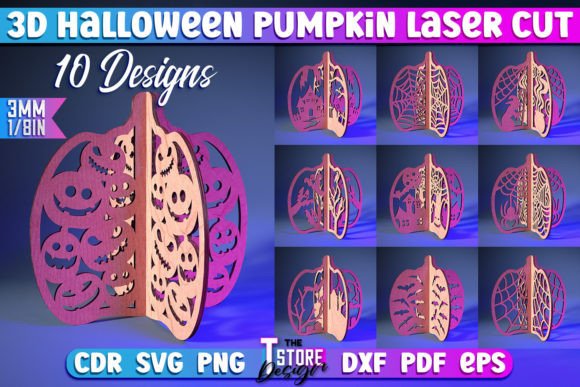
One of the primary considerations when selecting a digital design is file compatibility. A robust package for a 3D Halloween Pumpkin Laser Cut SVG project usually includes a variety of formats to accommodate different hardware and software ecosystems. Common archives often contain ten or more variations of the same design in formats such as SVG, EPS, PNG, PDF, and DXF.
- SVG (Scalable Vector Graphics): Ideal for web-based design tools and many entry-level laser controllers.
- DXF (Drawing Exchange Format): The industry standard for CAD software and industrial CNC machines.
- EPS and PDF: Frequently used in graphic design suites like Adobe Illustrator or CorelDRAW.
- PNG: Useful for previewing the design or for machines that utilize raster images for engraving reference.
Before acquiring a file, users must verify that their specific cutting machine and associated software can import and process these formats. While SVG is widely supported, some older CNC controllers may require DXF files for optimal path calculation. Additionally, users should confirm if their software automatically recognizes color-coded layers for cutting and engraving or if manual layer separation is required. If a specific file type is missing from a standard archive, many creators are willing to provide alternative formats upon request, ensuring that the design aligns with the user's technical setup.
Benefits and Practical Applications
The decision to utilize a 3D Halloween Pumpkin Laser Cut SVG often stems from the desire for a high-end aesthetic that is difficult to achieve manually. The primary benefit is precision. Laser cutters can reproduce intricate slot patterns with sub-millimeter accuracy, resulting in a professional finish that hand-cutting cannot match. Furthermore, these designs are highly scalable. Because they are vector-based, the pumpkin can be resized to fit various spaces, from small table centerpieces to large porch displays, without losing image quality.
These projects are particularly well-suited for:
- Small Business Production: Makers selling holiday decor can produce consistent, high-quality units rapidly.
- Educational Workshops: The assembly process teaches spatial reasoning and engineering principles.
- Home Decoration: Enthusiasts can create unique, custom-colored displays that stand out from mass-produced plastic items.
The layered nature of these pumpkins also allows for creative lighting integration. By leaving certain sections uncut or using translucent materials, users can insert LED lights to create glowing effects, enhancing the festive atmosphere.
Tradeoffs and Considerations
While the results are impressive, there are tradeoffs to consider. The most significant factor is material waste. 3D puzzle designs often generate more offcuts than simple silhouette projects due to the internal geometry required for structural integrity. Users must plan their material layout carefully to minimize waste, especially when working with expensive hardwoods or specialty acrylics.
Another consideration is assembly time. Unlike a flat sign that is ready once the machine stops, a 3D pumpkin requires manual assembly. Depending on the complexity of the 3D Halloween Pumpkin Laser Cut SVG design, this can range from a quick ten-minute task to an intricate hour-long process involving glue or friction fitting. For those looking for instant gratification, the post-processing time may be a drawback.
Material selection also plays a critical role. The thickness of the material must match the design specifications. If a file is optimized for 3mm plywood and the user attempts to cut it with 5mm stock, the joints will not fit. Conversely, using material that is too thin will result in a wobbly structure. It is imperative to check the designer's notes regarding recommended material thicknesses before starting the job.
When to Choose Alternatives
There are scenarios where a 3D laser cut design may not be the optimal choice. If the goal is speed and high-volume production of simple decorations, a 2D silhouette might be more efficient. Similarly, if the available equipment lacks the precision required for tight tolerances—such as a dull blade on a vinyl cutter or a misaligned laser—a 3D puzzle may fail to assemble correctly. In such cases, simpler designs with fewer interlocking parts or those intended for gluing rather than friction fitting may yield better results.
Additionally, users without access to vector editing software may find it challenging to modify these files if adjustments are needed. While many archives include ready-to-cut files, the inability to tweak dimensions or alter slot widths can be a limitation for advanced users who wish to customize the design extensively.
Making the Right Decision
Ultimately, selecting a 3D Halloween Pumpkin Laser Cut SVG depends on balancing aesthetic goals with technical capabilities. For makers who value dimensionality and are comfortable with machine calibration and manual assembly, these files offer a rewarding project with professional outcomes. Success relies on verifying file compatibility, adhering to material thickness guidelines, and understanding the cut versus engrave line protocols.
By carefully evaluating these factors, crafters can ensure that their Halloween projects are not only visually striking but also technically feasible. Whether for personal enjoyment or commercial sale, the right digital design serves as the foundation for a successful fabrication process, turning raw materials into festive art.